




Thirty-five years ago today, John Lennon was shot dead in the archway of his Upper West Side home at The Dakota on 72nd Street and Central Park West.
While living in New York City, Lennon was befriended by popular rock and roll photographer Bob Gruen, who had, since 1970, been shooting concerts and press photos for acts like Elvis Presley, Bob Dylan, Marvin Gaye, Little Richard, and many more.
Gruen would go on to document the rise of punk rock in NYC around CBGB's and elsewhere, working with artists like Patti Smith, the Ramones, and Blondie while also shooting some of the best known photos of mainstream bands like Led Zeppelin, KISS, Bob Marley, and David Bowie.
Throughout the 70s, Lennon and Gruen developed a friendship that afforded Gruen a special perspective on Lennon's life, the result of which are some of the most iconic photos ever taken of Lennon and Yoko Ono.
I had the pleasure of sitting down with Gruen in the West Village recently to discuss some of his storied history and most well known shots, locations around NYC and the 10th Anniversary Edition of his photo book, John Lennon: The New York Years, Revised Edition.
Today, we're sharing a portion of the interview relevant to John Lennon in honor of his passing almost 40 years ago today, along with three of Gruen's most ubiquitous images of Lennon in NYC.
Pete Destefano: You made an anniversary edition of your John Lennon book that came out in October, what was that like?
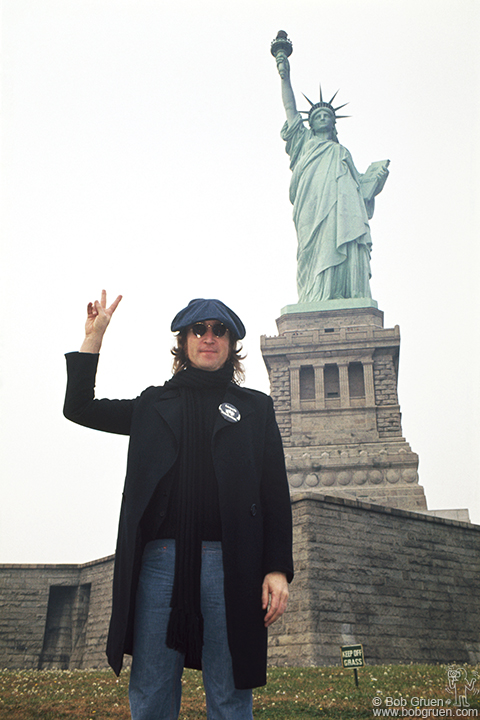
John Lennon, NYC 1974 / Credit: Bob Gruen
Bob Gruen: Well, it's been ten years since the book came out. It's still in print, people still like it. You know, it's remarkable that 35 years after he passed away, people are still so interested in John Lennon. We've added 16 new pages with 24 new pictures, and I didn't have to change the text.
I got a lot of compliments on the text when the book originally came out. It's my story of knowing John Lennon, getting to be his friend the whole time he was here in New York in the 70s, so it covers all that. We have a new cover as well.
PD: I'm especially interested in this page. Why specifically did you choose this image out of the whole spread?
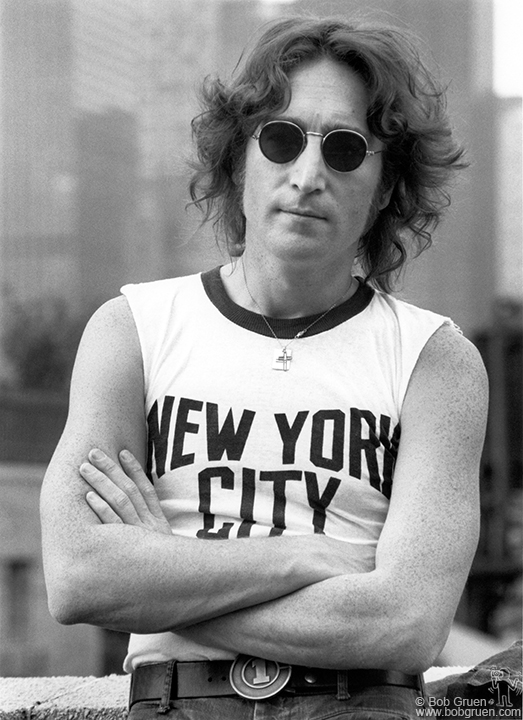
John Lennon, NYC 1974 / Credit: Bob Gruen
BG: It was just the strongest one. You can see the progression between this picture and the rest because there's a different lens involved. When you're doing a photo session you're shifting lenses, of course I had two different cameras-- a black and white one and a color one-- but only one lens.
You know you don't get too many lenses, they're expensive. So I was switching back and forth. You can see in this one that the background is quite different. It's much more pronounced, the different features of it. Whereas here it's much smoother and more distant, that's what a portrait lens will do.
It all just fell into place. Here he's moving around, he's a little fidgety, until finally, he just relaxes, settles in, and he's comfortable.
I like pictures where people look comfortable, it makes the viewer comfortable. It transfers that kind of feeling.
He just looks comfortable but at the same time confident, open and available, even with the sunglasses-- kind of a pop star look-- we were friends by this time so he was very open and comfortable.
,PD: (referring to the previous rooftop photo) Is it true that he's wearing your shirt?
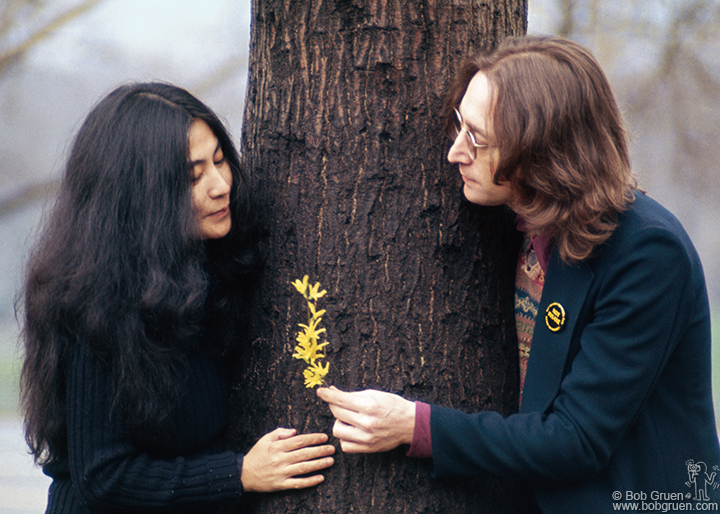
Yoko Ono & John Lennon, NYC 1973 / Credit: Bob Gruen
BG: No, I bought the shirt, and I gave it to him. In peoples' minds, with rumors, it's kind of like, "I took my shirt off and I gave it to him." No. I gave it to him a year earlier. I used to wear shirts like this all the time, I probably had about six of them. I could have taken it off and given it to him.
It wasn't made by a store or a company, it was made by some guys who sold them on a blanket in Times Square.
When I first saw it, I liked the graphics of it and I bought one. I liked it a lot, so whenever I saw them, every couple of weeks or couple of months, I'd be riding my bicycle around New York and I'd see them in Times Square and I'd pick one up, or a few.
One night, I was going to visit John who was recording at the Record Plant I was walking through Times Square to go there and I picked up a shirt. I cut the sleeves off with a buck knife because it gives it more of a "New York" kind of look.
I thought it's a little corny with the sleeves on, so I gave it to John in the studio that night.
A year and a half later, he invited me over to his apartment on the East Side to take pictures for his Walls and Bridges album cover.
Afterwards, he suggests we take some pictures up on the roof. We started taking some and he had a black tee shirt on and I asked him, "Do you still have that NYC shirt I gave you a year ago? This would be a perfect background."
I was impressed because, you've heard about the "Lost Weekend?" [About a year of Lennon's most veracious partying.] I'd given him the shirt, let's say, "Friday morning," and let's say this was now "Monday night," but he knew exactly where it was and went and put it on.
I knew he liked it because he still had it with him; he hadn't lost it.
Someone once told me about this picture, that it's "self-revelatory," in that it says "New York City" and it looks like New York City.
I thought, 'There's an expression I could use in academic circles: self-revelatory.'
It's hard to describe why a picture appeals to people. I like to think my pictures describe a feeling as well as the facts. It's not just what color shirt he's wearing, but what the feeling is.
And sometimes you can't focus exactly on time, so the subjects aren't sharp, but the feelings are clear. When somebody says they can imagine being there, that they can hear the picture, that's the best kind of compliment I can get.
Keep an eye out for our full interview with Bob Gruen coming up soon, and take a look at Gruen's web store for stunning photo books on The Clash, John Lennon, The New York Dolls, and a fantastic hardcover called, Rock Seen, which documents his entire career with the stars.
Check out Broadway's 'Allegiance' Shows Us How Un-American We Can Be.
[Feature Image Courtesy Morrison Hotel Gallery]