
The subtle double honk of a car horn. The faint whir of a jump rope in rotation, the soft thud of feet stepping in time. The ding-ding-a-ding-ding-a-ding of the triangle.
“A here we go, a here we-"
“ARNOLD!"
You heard Helga Patacki’s voice ringing out in the distance and you knew immediately what was happening in two of the most interesting words to echo out of the 90s: Hey! Arnold.
It’s one of the most alluring intro songs of any TV show in the history of television, and arguably the best use of a saxophone ever.

The show, set in New York City, gave kids growing up there an interesting view of their own backyard; one with a wide cast of characters as diverse as the city itself; one with a sense of place and purpose in it; a burgeoning, welcoming community that seems to have aged out as quickly as the show did.
For kids growing up in the city, it illuminated a certain realism other cartoons had not yet delivered (nor ever would). For kids growing up elsewhere, the fiction was an escape that felt just within reach, but was far away enough to look forward to.
But what, besides the enchanting theme song, was so great?
What about the show has such a timeless appeal, and is it actually timeless, or is there such a void in our current culture of storytelling that we're blinded in our nostalgia? Will we ever see any incarnation of a kid as good and original as Arnold? Will you join us for The Dopest #TBT Ever?
Seriously. We can talk then.
Using two writers to answer 4 essential questions, we're bringing you this tale of two sittings; one from Isaiah Cruz, contributing writer for spoiled NYC, who grew up in Queens; the other from Jamison Hackelman, managing editor for spoiled NYC, who grew up in the cul-de-sacs of North Carolina.
Read on to figure out why you'll never forget the adorable football-headed kid who was everything you could never be.
1. Put this show into context. Describe your childhood, the setting, the vibe of the neighborhood, etc.
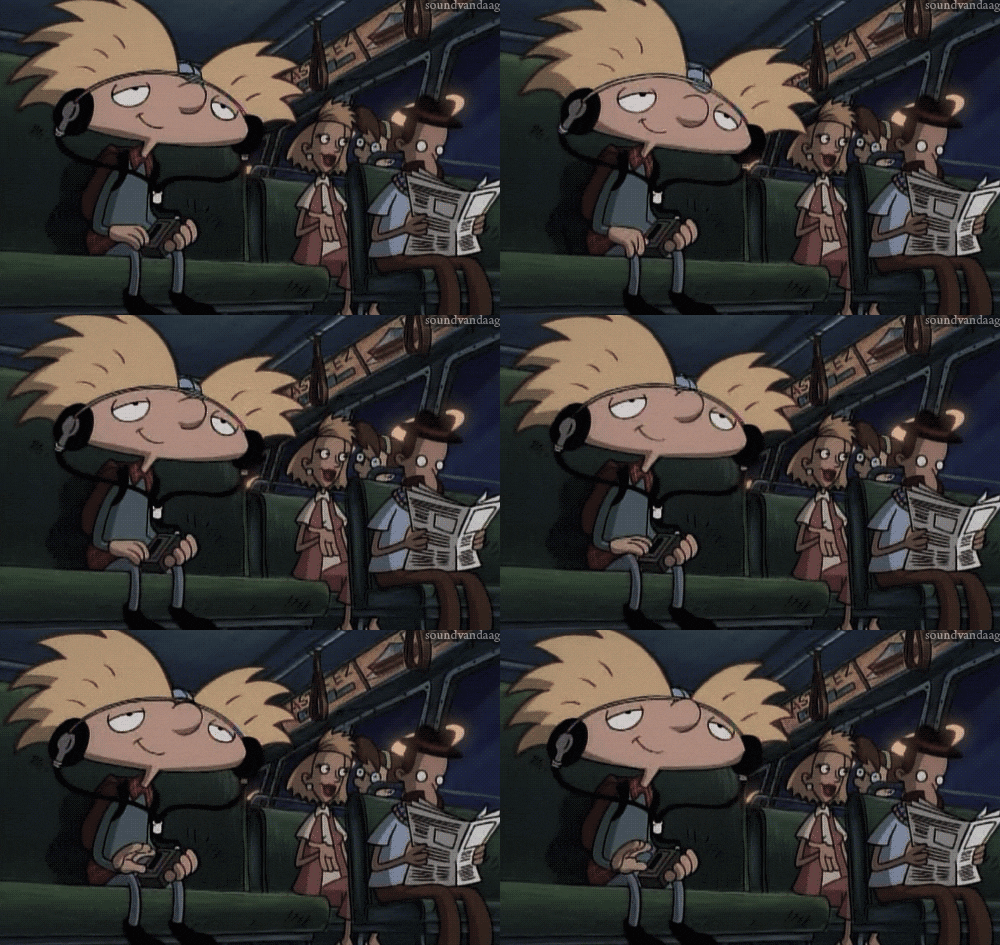
IC: I was born and raised in Queens, New York. For the first seven years of my childhood, I grew up in the projects in Woodside. It was an extremely diverse and community-oriented neighborhood.
All of the kids came outside and played in the courtyards while parents and adults either watched from windows, or hung out with each other while we kept ourselves entertained after school and on the weekends.
Everybody basically knew each other and kept an eye out for the neighborhood kids.
JH: When the show first premiered we were living in what I've come to realize was a kind of downtrodden, urban neighborhood on the outskirts of Greensboro, North Carolina. We had to store our bikes inside because they kept getting stolen and pawned off.
It had the look and feel of a quiet, suburban neighborhood, but as my mom would later inform me, it definitely wasn't.
Now, in the show's heyday we had moved into a country club neighborhood in Wilmington, NC which was quite a departure from the cartoon grit of Arnold's neighborhood. I lived near golf courses, peaceful meadows, and a general, expansive whiteness.
We didn't have to overhaul a jacked up block of lawn to safely play football or baseball. We didn't walk the long blocks in the hot sun for a bag of ice that melted before we got home, and the whole Sunset Arms tenant situation was an entirely foreign idea.
2. How did the show inform or influence your understanding of New York City?
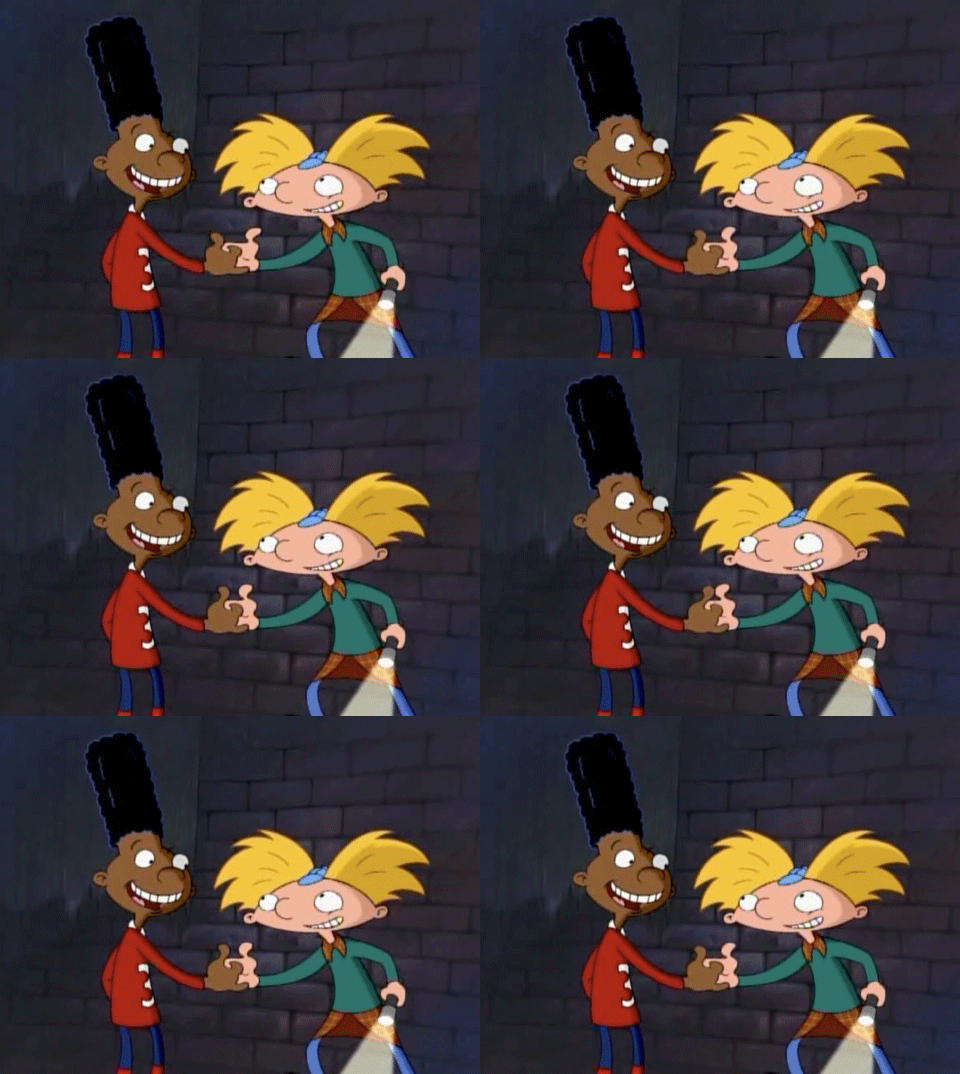
IC: Much like Arnold, I grew up in a very heterogeneous neighborhood among many different ethnicities and cultures, a given when living in New York City.
However, seeing that element depicted on the show just solidified this as “normal” for me, unlike someone who grew up in the Midwest or the suburbs or a likewise less gentrified area. I grew up thinking everyone lived together, despite race and color.
As to the city itself, it gave me a better insight, however exaggerated, of things in the city I hadn't experienced yet.
For example, in the episode where they all try to go home on the subway because it’s late, although they were gross overstatements of the actual subways, it tackled a number of fears I had about the subway, such as getting on the wrong train or coming too close to creepy or homeless people.
So when I first started taking the subway a few years later, I was already privy to some of the things to be wary of down there. I guess you can say it overly prepared me for the experience.
JH: Arnold's NYC wasn't touristy. It wasn't celebrating skyscrapers or statues. It had a sense of place without branding itself as a postcard. If Home Alone 2 gave you everything you needed about NYC (and I thought it had), then you didn't know what you were missing.
In elementary school we learned about America as a melting pot of cultures. Even in the somewhat rural suburbs I assumed that all of America was supposed to be like this. With Arnold, you got the a definitive microcosm of that assumption even if it didn't prove true everywhere else.
Turns out, Arnold's NYC was more accurate than most any depiction I've seen since.
Sure, the lens through which the story was told was the original white hipster, but the show engaged in heady cultural and social topics that no other cartoon seemed ready to grapple with just yet.
Arnold gave you a cast of characters as diverse as the world you assumed actually was, but couldn't quite see for yourself. It was escapism to a degree, but not because of the fictionality of it. Despite it being a cartoon, there was something very real about his community that hit home wherever you were.
In looking back at this show as the experience of one kid interacting with NYC in the mid-90s, you didn't realize how little school had taught you about the world you lived in or would face. Arnold was its own education, and one of very few shows to illuminate truth the way it did.
3. Let's talk about nostalgia. What is it from Arnold that you wish for today? Is there any element of him present in any other show, or was he an anomaly?
IC: Although it wasn’t exact, I grew up in a pretty similar setting as Arnold did. My nostalgia comes from that sense of community, living in an environment where everybody knew each other, and their families.
We have this very individualistic way of living in the city where actual communities scarcely exist anymore, to the extent that we actually avoid our next door neighbors so we don’t have to have a conversation with them.
New York City has lost its neighborhoods, especially with the recent influx of development for the luxury lifestyle in what used to be melting pots of culture and community. Now, they’re an ever-changing, revolving door of tenants, tourists and high-rises.
Hey! Arnold was unique because there was no show that depicted “real life” the way it did, maybe with the exception of Recess, and I don’t think there has been one since.
JH: I miss Arnold, plain and simple. I look at TV, and sure, my tastes have very much matured, but I don't see any element of the kid I didn't have to root for; the kid who was good hearted on his own without having to question whether any part of him was bad.
Let's talk about the men on television, because if time is a flat circle, that's what Arnold is now.
The best shows on TV thrive in this grayscale characterization where every leading man seems to be grappling with the tarnished condition of their souls.
Tony Soprano, Jimmy McNulty, Don Draper, Walter White, any of the True Detectives, none of them, despite brief moments of goodness, actually are, or ever become good men. This level of introspection is growing tiresome.
It's not that I'm tired of dynamic interactions that challenge and have the potential to change a character. It's that I'm tired of the inevitability that redemptive or transcendent change is impossible.
Point is, what has happened to our perception of the good kid?
Have we convinced ourselves that goodness as an idea is too fictional to even write about? Or are we actually so bad that our fiction, naturally gravitating towards this uneasy sea of scumbags, is the only way we can resolve to ourselves that we aren't as bad as we think? Do we already know that we can't change?
I get it. Cartoons aim to do very different things than HBO or AMC drams, but I'll safely venture out into melodrama here: no one on television has ever been as wholly good as Arnold was, especially considering how gritty and real the world Arnold interacted with was.
Nobody is giving the Stoop Kid courage to step away from the stoop. Nobody is tutoring Torvald. Nobody is defending Eugene beyond a reasonable doubt. Nobody is visiting Principal Simmons, saving Dino Spumoni from himself, or conducting a sit-in during a teacher's strike. Arnold is an anomaly.
4. Consider the current state of popular culture as one of adaptation, rebooting and re-imagining. What would Arnold look like now? Would he survive in this time?
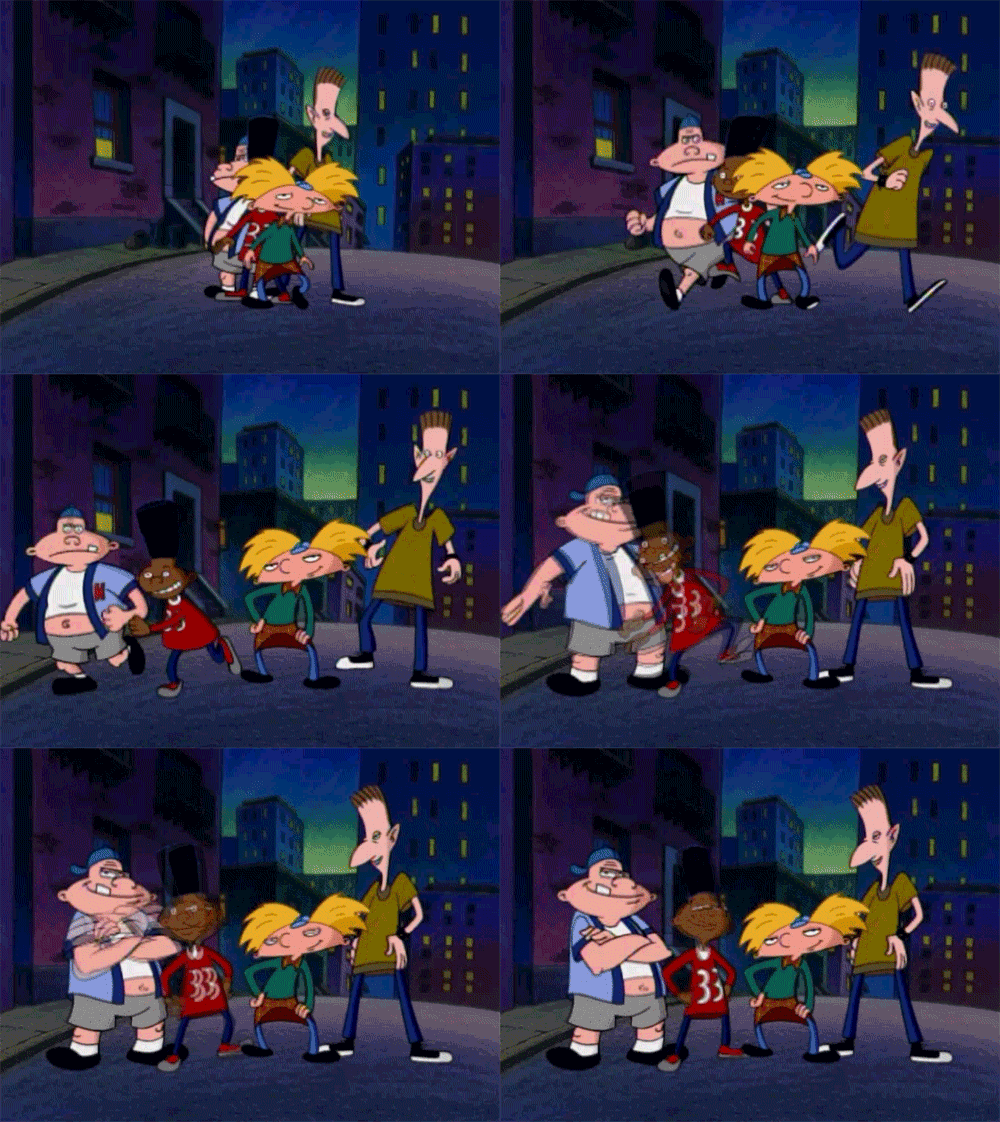
IC: If they did a reboot of Hey! Arnold, it would have to be done either as a time-period cartoon because New York City is no longer the way it’s portrayed in the show, or they would have to do a “Where Are They Now?” type show, a la the new Girl Meets World on Disney Channel, showing the gang all grown up with jobs and families and a new generation of kids discovering themselves and the city they live in.
If you took the entire cast and plopped them into 2015, I think they’d survive, but they also would have no idea what hit them. Unfortunately, the NYC of the Hey! Arnold years is a far cry from the modern day New York we live in.
And that’s probably the saddest consequence of nostalgia that re-watching the show now evokes.
In a modern telling, I could see that Arnold and Helga are married, teased by the synonymous relationship his grandparents had when they were little, and they’re the loyal ones who have clung to the old neighborhood as they watch the city around them change.
Grandpa Phil and Grandma Gertrude have sadly passed on, and that’s what fuels Arnold’s desire to stay in the neighborhood and “hold the fort down” at The Sunset Arms for the sake of their memories.
Their old friends come to visit intermittently; Gerald plays for the NBA, Phoebe is a brainiac scientist, Curly, who for all intents and purposes just shows up and no one really knows what he does (turns out he became part of the CIA), and so on.
But the main point is Arnold and Helga (though, mostly Arnold), clinging to the nostalgia of the old neighborhood, balance the pros and cons of staying true to your roots with the rest of the gang’s acceptance that this city is no longer the one they grew up in as they see their childhood friends all moving on in a “new” city.
JH: You only need to go as far as Rugrats All Grown Up to see how bad of an idea this would be. That said, I like this idea of Arnold sticking around trying to make Sunset Arms work, and I think Arnold as a show, unfortunately, is safe.
Again, In the world we're currently writing, I think we'd have this weird, cultural inclination to write Arnold as jaded or disillusioned; crotchety, even, rallying against gentrification or what we'd perceive as progress.
We're not fostering a culture where good-naturedness resists temptation and thrives unbroken, and that's what was so unique about his character. Consider the grittiness of his New York City.
Currently, I don't even see any cartoon for kids that relates to the demographic Hey! Arnold so well. He was a 4th grader capable of seeing the best in everyone, and kids nowadays have access to too much of the world to carry themselves as bright-eyed and eager and survive.
Kidding. Arnold's NYC was pretty dark. Consider the Pigeon Man, the illiterate Oskar, the episode where Arnold gets mugged, the condition of the school, stickball in the vacant lot, the homeless and impoverished.
Adventure Time is probably one of the most popular cartoons on TV right now, and even then you have to consider that its setting, the post-apocalyptic Land of Ooo, by definition of being "post-apocalyptic", is a world trying to move forward from some element of humanity it could no longer sustain.
We're much too fascinated with showing the hypothetical of "How Bad Can the World Get." Arnold was a show about kids interacting with New York City directly in the muck and grime it was. The setting wasn't part of the fiction in Hey! Arnold.
I feel like the world right now is almost too messy for Arnold, and as much as kids might need someone like Arnold in their lives, is anyone ready to grapple with the issues at hand in an intelligent light? Anyone ready to have Gerald talk about #BLM, or put the NYPD as a questionable, shady villain-type light in a kid's show?
Yeah, this world's too real for Arnold.
Check out 9 Reasons New Yorkers Wish They Lived in the 'Friends' Version of NYC.