
If you've spent any time at all in New York City, you've passed, been solicited by, and tried to ignore homeless people.
It's a fact of life for residents of this city: every day while we carry expensive bags, wear expensive clothes and shoes, and carry money in our expensive wallets, we walk past people with little more than the clothes on their backs.
The fact is, homelessness is a much more pervasive catastrophe than many of us would like, and many of us contend daily with the moral dilemmas regarding the homeless.
Essentially, at the heart of it all, the question we ask ourselves, whether we readily confront it or not: What do we owe each other?
It's a matter of social responsibility, human decency, morality, and self-preservation.
To answer this question and others, we've contended with this disaster below.
1. We owe each other the facts
NYhomeless.tumblr.com
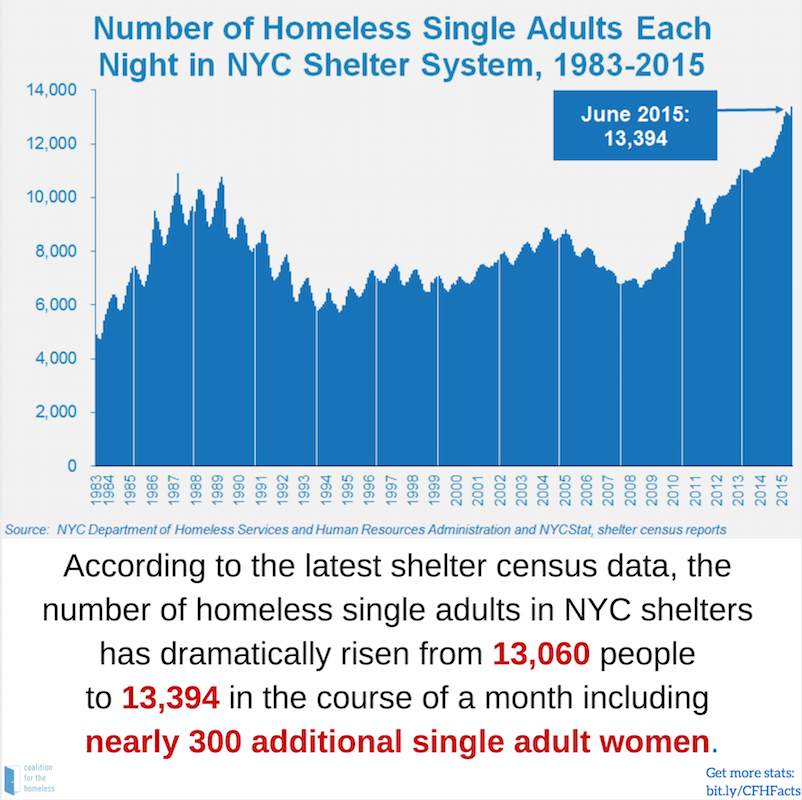
Too many New Yorkers are homeless. Of NYC’s 8.3 million residents, The Coalition for the Homeless reported that in June of 2015 there were 58,761 homeless people sleeping in the New York City municipal shelter system each night.
This includes 14,031 homeless families with 23,692 homeless children. What’s worse is that families comprise nearly four-fifths of the homeless shelter population.
And these numbers don't even include the homeless people who don't sleep in NYC's shelter system. We can't turn a blind eye to its ubiquitousness.
The homelessness situation in NYC is not improving. The number of homeless New Yorkers who spend their nights sleeping in municipal shelters is 72% higher than it was a decade a ago.
Yet every day some guy gets on the train and says, "Can I please have your attention?" and shakes a cup of coins in our faces, and most of us don't even look up. We owe each other the facts, and homelessness, beyond all statistical manipulation, is a painful fact.
2. We owe it to each other to accept these these facts as critical to understanding the city itself
zouzbekdache.tumblr.com
When we talk about understanding the city, the essence of that discussion begins and ends with the cost of living. Yes, this city's too damn expensive. Yes, we're a generation of consumers forever perfecting the life hacks, perpetuating this enduring vision of the cheaper way out.
There are some things we cannot influence as much as we'd like. For every little life hack, there's still the average rent for a one-bedroom apartment in NYC at $3,039 as of May 2015.
Homelessness in NYC has increased alongside an increase in NYC’s cost of living. The cost of living in NYC has increased by 20% in the past five years, while the number of homeless New Yorkers increased concurrently. To ignore this correlation would be absurd.
On Tuesday, Mayor de Blasio spoke about NYC's rampant homelessness on "The Brian Lehrer Show," stating that many of the city's homeless can't afford the cost of living in NYC. He also said part of the issue is the end of housing subsidies that have kept many people off the streets.
Last week, a woman panhandling with a newborn near Grand Central was arrested and charged with endangering the welfare of a child and aggressive panhandling.
The arrest followed a series of reports that found this woman and others might be involved in a coordination scheme to exploit children. The woman, Caselina Margel, was ordered to have no contact with her child, who was placed in custody of his father.
Mayor de Blasio said he was appalled when these women's coordination was discovered last November, but at that time the NYPD said its hands were tied because panhandling with children on city streets is not illegal.
,3. We owe each other advocacy
NYhomeless.tumblr.com
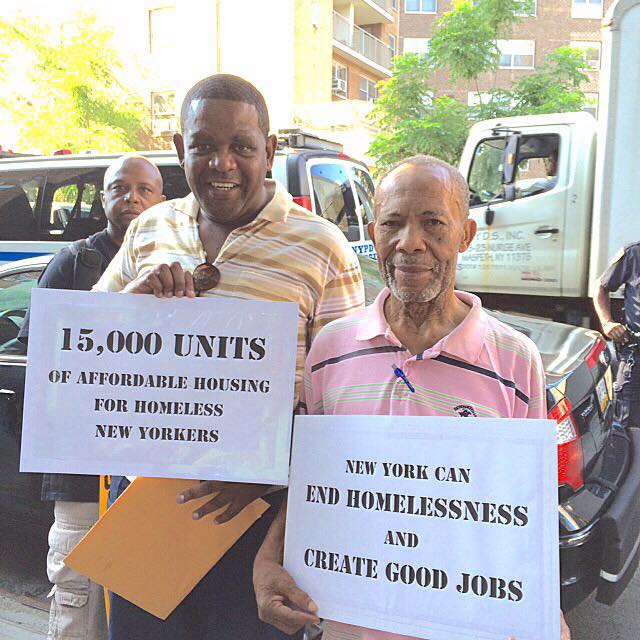
The New York Housing Authority is devoted to increasing opportunities for low-and moderate-income New Yorkers by providing safe and affordable housing with average monthly rents of $464.
However, in May of 2015 there were still 270, 201 families on the waiting list for Conventional Public Housing, 121,356 families on the waiting list for Section 8 Housing, and and 17,398 families on both waiting lists. It’s clear that NYCHA needs more resources to fulfill a very real need.
Surveys of homeless families identified these triggers of homelessness: eviction, severely overcrowded housing, domestic violence, job loss, and hazardous housing conditions.
Research has also shown that homeless single adults have high rates of serious mental illness, addiction, disorders, and other severe health problems.
In 1990, Mayor David Dinkins and Governor Mario Cuomo established a city-state partnership called New York/New York. It established thousands of units of supportive housing, and provide apartments and services to help people with mental illnesses and other disabilities.
The New York/New York partnership has been renewed periodically throughout the years, but it's set to expire in 2016. So what kind of legislation will NYC's officials come up with after that?
Advocates for the homeless have been campaigning for New York/New York that would generate 30,000 supportive housing units. It's a huge number of housing units that require large-scale funds, but it's what's necessary to solve the problem.
As to how much more money the city would need to put into the program for 30,000 units? Well, currently Governor Cuomo's budget supports only 3,900 units.
4. We owe each other common human decency
Via Slate
Two weeks ago, the NYPD sergeants' union urged its members and supporters to document the deteriorating quality of life in the city by taking pictures and videos of homeless people and posting them on its Flickr site. After a tsunami of criticism, they removed the photos from their site.
Most of us aren’t in the NYPD and can’t influence what it does, but this post reflects a deeper social chasm. We need to stop construing the people who need support the most as a joke to be gawked at, or anything less than human.
Sleep is a life sustaining activity, and the federal government has recently decreed that it's unconstitutional to ban the homeless from sleeping outside.
This still hasn't prevented people from installing "bum-free" studs on their staircases and spikes on ledges to prevent homeless people from sleeping. These heartless structures amplify the tension about what qualifies as public and private property.
Regardless, we owe each other the human decency not to humiliate. The NYPD tried to empower people to participate in ridding the city of "quality-of-life offenses," using extremely unsettling language.
We are not in a separate class of existence from homeless people. We owe each other acknowledgement of humanity, and that means abandoning all inclination for humiliation and these horrific, spiked, "anti-bum" structures.
Check out 8 Moral Dilemmas Every New Yorker Faces When Living in this City.