




Does the idea of rent control sound like an urban myth to you? Is it a concept clouded by folklore, something you're not sure whether it's real?
Everyone has a story of someone's friend's uncle's cousin who lives in a rent-controlled apartment and pays $500 to live in the East Village. Do these people really exist?
The answer is sort of, but only for people who have lived continuously in an apartment since before 1971. Sounds confusing, doesn't it?
We're here to explain the lowdown on rent control.
Sadly, most depressingly, the median rent in New York City is $3,000 per month, according to Trulia. Needless to say, most of us can't afford that.
So whatever do we do? Well, get roommates is the obvious answer. The second most obvious answer is to get a rent-controlled apartment.
Contrary to popular belief, a rent-controlled apartment does not prevent a landlord from raising the rent. It just controls how much the landlord can raise the rent throughout the course of a tenancy.
In NYC, there are two types of rent increase restrictions: rent stabilization, and rent control.
For an apartment to be rent-stabilized, it needs to be: in a building with six units or more, and in a building that was built between February 1st 1947 and January 1st, 1974.
For an apartment to be rent-controlled, it must: be in a building constructed before February 1947, and have a tenant that has lived in that apartment continuously since before July 1st, 1971.
If a tenant in a rent-controlled apartment moves out, that apartment is no longer rent-controlled. If the apartment's building has more than six units, the apartment becomes rent-stabilized. If the building has less than six units, it becomes deregulated.
So future rents will be determined by the market. Future tenants will slog through the lunatic prices determined by market value.
Here's the big question: how much can landlords increase rents in rent-stabilized and rent-controlled apartments?
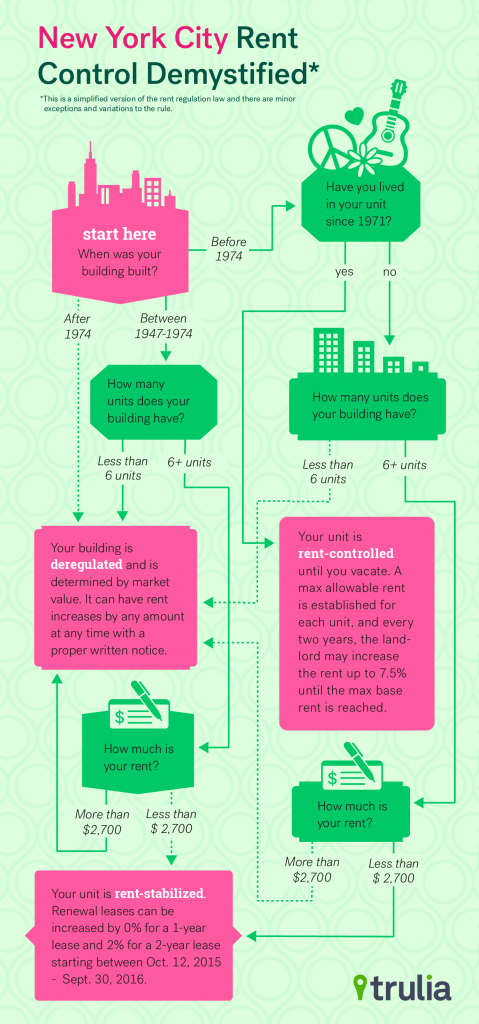
Via trulia
For rent-stabilized apartments, the answer is determined by an annual vote among the city's nine members of the Rent Guidelines Board.
This year, in an unprecedented move, that board decided to freeze rents on one-year leases that started between October 1st, 2015 and September 30th, 2016. Which means, rent increases are not allowed.
However, for 2-year renewal leases beginning between October 1st, 2015 and September 30th, 2016, a 2% increase is allowed.
Sadly, in rent-controlled units, landlords are allowed to raise rents up to 7.5% every year until they've reached the maximum base rent, which is different for every property.
Wondering where in the world to find a rent-stabilized apartment? Great, we've got a handy list for you right here.
Renting in Inwood is the move, as 79.6% of apartments are rent-stabilized in Inwood. In Washington Heights, 69.8% of apartments are rent-stabilized. This number drops to 38.43% in Harlem, and even further to 35.14% on the Upper East Side.
Thus, it follows that it's safe to assume the more affordable the neighborhood, the more likely you are to find a concentration of rent-stabilized apartments.
This "How Much Rent Can You Afford?" Calculator Will Ruin Your NYC Dreams. Forever.
[via Trulia]